A decades-old portrait and a student film crew bring a Michigan history maker to campus
February 11, 2026
The documentary “Best in Class: Blenda J. Wilson, Jon Onye Lockard and the Portrait that Connected Them” premiered at UM-Dearborn on Feb. 11.
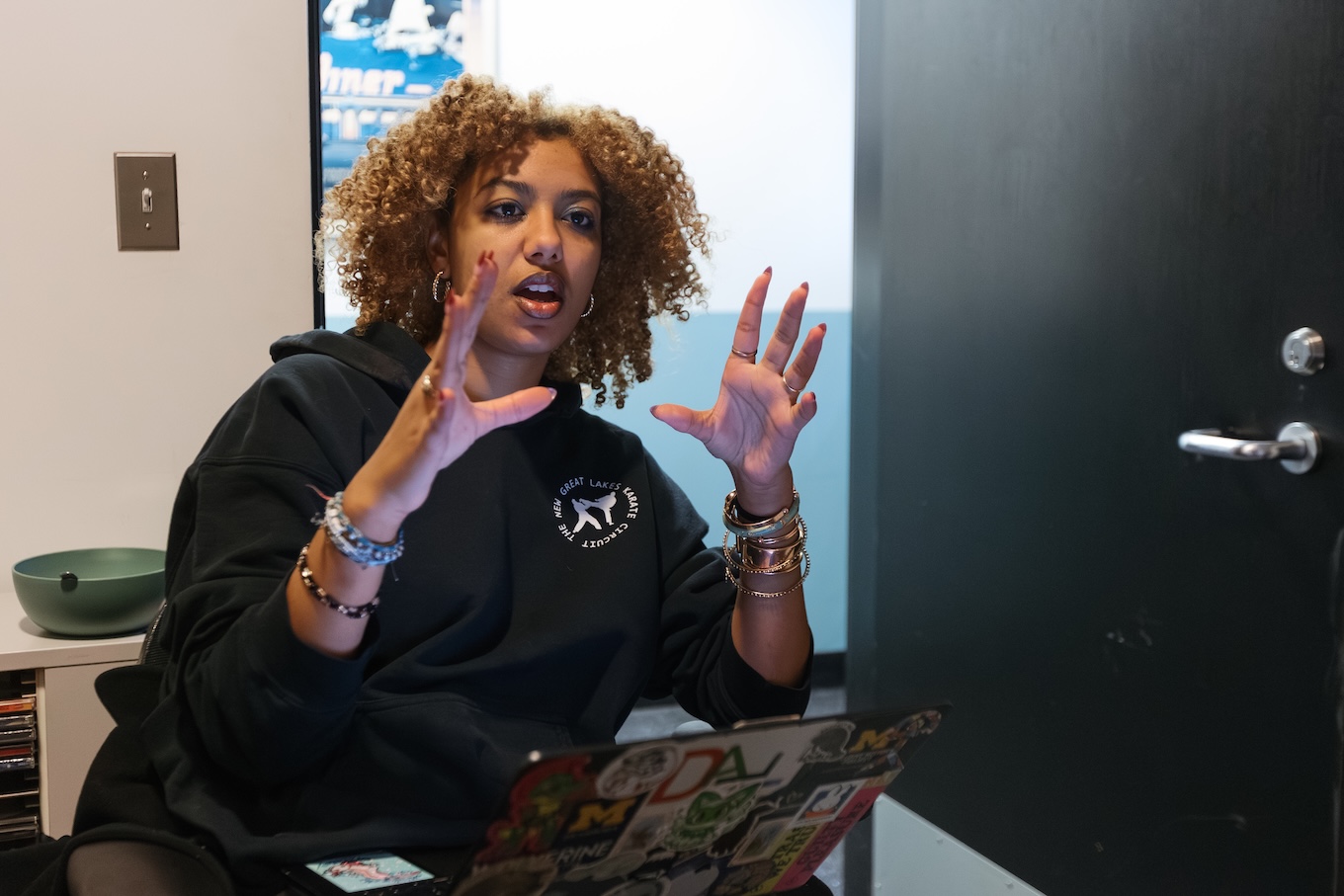
College of Arts, Sciences & Letters students, from left, Marcos Carrillo and Ben Filler edit the documentary "Best in Class" on Jan. 30 in the JuMP Studio.
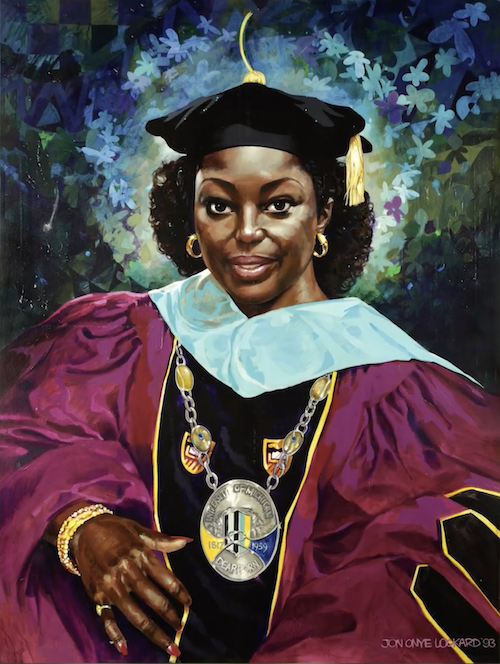
A picture is worth a thousand words — and, in the case of former Chancellor Blenda Wilson’s official university portrait, it’s worth a documentary film.
The portrait of Wilson — who’s the first woman to head a four-year public university in Michigan — sat in the Mardigian Library archive for years until it caught the eye of Professor of Middle East and Iranian Diaspora Studies Cam Amin in 2023 while he was doing research. “It’s like Blenda kept us company in the archive. The image is so vibrant and eye-catching — it’s not what you’d think of when it comes to an administrator’s picture,” said Amin, who is the director of research at UM-Dearborn for the Inclusive History Project. “Looking at the portrait, I wanted to make sure we remember and preserve the impact she, and many others, have had on our university.” Wilson, also the state's first African American woman to lead a four-year public university, was chancellor at UM-Dearborn from 1988 to 1992.
The portrait of former Chancellor Blenda Wilson by Jon Onye Lockard
Not long after his encounter with the portrait, Amin shared how much he appreciated it with UM-Dearborn’s Inclusive Storytelling Hub team, and they started digging into the image’s history. Led by Instructional Learning Assistant Rick Morrone and Associate Professor of Journalism and Media Production Jen Proctor, ISH is a team of student storytellers who collaborate with faculty to transform their research findings into compelling narratives.
Fueled by Amin’s enthusiasm, the team explored several archives — from national to local — and embarked on a journey to locate Wilson. What the ISH team discovered led them to create the documentary “Best in Class: Blenda J. Wilson, Jon Onye Lockard, and the Portrait that Connected Them.” See the teaser. Lockard, a pivotal figure in the Detroit Black Arts Movement, painted the portrait. Painted portraits of chancellors were an early university tradition that has been discontinued. Photographs of past chancellors are displayed in the university’s Administration Building.
The 30-minute documentary — directed by Morrone and executive produced by Proctor — premiered at a screening event from 6 to 8 p.m. Wednesday, Feb. 11, in Renick University Center’s Kochoff Hall. A reception and panel discussion took place after the screening. Wilson, who now lives in New Jersey, attended the event. The film will be put online in the near future.
“UM-Dearborn has such a special place in my heart and having a documentary that includes me is such an honor,” said Wilson during a recent phone interview. “All of those years ago, I wanted to lead UM-Dearborn because I saw myself. I am a first-generation college student. I also saw myself in much of the Dearborn and Detroit community and I understood the struggles people faced and the barriers to a college education. I wanted to do what I could to increase education access.” During Wilson’s leadership, enrollment among students of color increased from 5.7% in 1988 to 6.9% in 1992 through expanded scholarships and community outreach efforts.
Lockard, who died in 2015, is a history-maker in his own right. He was a senior art advisor for the installation of the Martin Luther King Jr. Memorial in Washington, D.C., and a founding faculty member of the Department of Afroamerican and African Studies at UM-Ann Arbor. Lockard’s contributions to DAAS include teaching, implementing conferences and symposia on the arts of Africa and curating art exhibitions.
Proctor, the ISH director, said “Best in Class” sheds light on two outspoken advocates for equity in education — Wilson and Lockard — and the way the portrait brings them together. “Going through archives and learning about Jon and Blenda, you can’t help but be inspired by both,” Proctor said. “We had no idea what we were going to learn when we began looking through the archives and reaching out to people for this project. We didn’t know that this portrait would lead us here. It’s exciting.”
ISH intern Jay Snyder-Phillippoff, a junior majoring in art history and anthropology and one of several students working on the film, serves as associate producer. She traveled to New Jersey last year to interview Wilson.
Junior Jay Snyder-Phillippoff is an associate producer for "Best in Class."
Known for her “can-do attitude” on the team, Snyder-Phillippoff helped move the project forward. She found Wilson through a bit of detective work. “Blenda moved quite a bit and she wasn’t on social media. I tracked her around the country, calling places in cities where she once lived. It took me almost a month to find her,” Snyder-Phillippoff said. “Then I called a retirement home in New Jersey that wasn’t too far away from where Blenda grew up. When I asked for Blenda Wilson, the operator said, ‘Let me connect you.’ I was shocked. I couldn’t believe it was actually happening.”
Snyder-Phillippoff said that the phone conversation led to an experience that she’ll carry with her beyond her time at UM-Dearborn. She was intrigued by the former chancellor’s historic leadership role and portrait — but became even more impressed after meeting Wilson.
“I grew up looking up to Tiana (from Walt Disney’s “The Princess and the Frog”) as a role model in my life because she was one of the few strong, positive Black females that I saw in the media. Meeting Blenda reminded me that there has been Black excellence for a long time and we have a lot to be proud of,” Snyder-Phillippoff said. “It’s such a privilege to meet Blenda and work on something that sparks people to think critically and have intelligent conversations. This film isn’t just to provide an interesting and beautiful viewing experience — it’s also to activate us to engage thoughtfully with the content.”
The ISH team’s favorite archive finds include a photo of Wilson with Civil Rights activist Rosa Parks during a 1991 UM-Dearborn commencement ceremony and 1990 video footage of Wilson offering a comedic retirement roast for former Vice Chancellor of Academic Affairs Eugene Arden.
The lighthearted moments in the documentary are tempered by more sobering ones. A May 1992 clip shows Wilson speaking to a U.S. Senate subcommittee about the importance of educational access throughout a person’s lifetime, from preschool through higher education — especially for at-risk youth. Wilson shared concern about how learning would be affected by increasing government cuts to public education, Proctor remarked.
“When Blenda testified before Congress, she said it feels like deja vu because she was fighting for the same things people were voicing concerns about 20 years before — she said that in 1992,” Proctor said. “Part of our documentary’s purpose is to address that, in 2026, we're still fighting for the same things that Blenda and Jon did in their advocacy work. Yes, it is a bit unnerving. But, together, what are we going to do about it?”
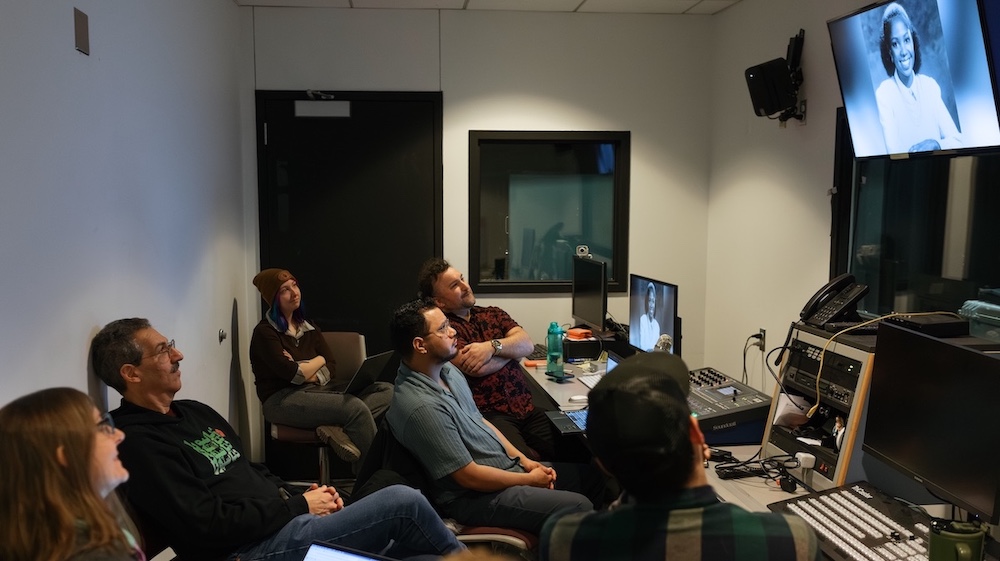
As the “Best in Class” premiere approached, the College of Arts Sciences & Letters JuMP Studio bustled with activity. The students, alongside Morrone and Proctor, were putting last-minute touches on the film. "I look at everything through a production lens and it's easy to get caught up in the technical aspects of a film,” Morrone said. “But when the content starts to pull me in, I know we have something special — and that's what this film did. I hope that’s portrayed to the viewer too. Our ISH student interns did an excellent job.”
A group of faculty, staff and students gather in the JuMP Studio to review and edit "Best in Class" on Jan. 30.
During the project, Snyder-Phillippoff said the team also made an interesting discovery about the portrait itself — they learned that Wilson had never seen it. Wilson selected Lockard as the artist, but she never sat for the portrait and it was finished after she left UM-Dearborn to become president of California State University, Northridge in 1992. She was the first woman and first African American to serve as president of CSUN, as well as the first Black woman to lead a U.S. campus with 25,000 or more students.
During the New Jersey visit, Snyder-Phillippoff was the first one to show an image of the portrait to her. Wilson’s reaction was captured on film. In her characteristic thoughtful manner, she took a minute for internal contemplation.
“I’m honored that Professor Lockard used his talents to represent my time as chancellor in such a beautiful way. I wish I could have told him that,” Wilson said in a phone interview. “I’m glad this film will bring us and our work together. I’m very grateful to the university for this.”
A copy of Lockard’s portrait now hangs in Wilson’s home. She saw the original one in person on Feb. 11 — nearly 35 years after it was painted. It was on display during the event.
###
In addition to Morrone, Proctor and Snyder-Phillippoff, the filming crew involved with “Best in Class” are CASL alum Anthony Fraga, former CASL student Jabez Williams, CASL student Ben Filler and CASL student Marcos Carrillo. The research team includes CASL student Adam Almaleky, Amin, UM-Ann Arbor student Wallace Bowie III, Digital Humanities Coordinator for IHP-Dearborn Marlaine Magewick, UM-Ann Arbor doctoral candidate Rebeca Maxon Sáenz, UM-Dearborn Assistant Archivist Hannah Zmuda and Lecturer of Journalism and Media Production Shelby Zuk. The project was funded by the Inclusive History Project.